Last updated August 2, 2026
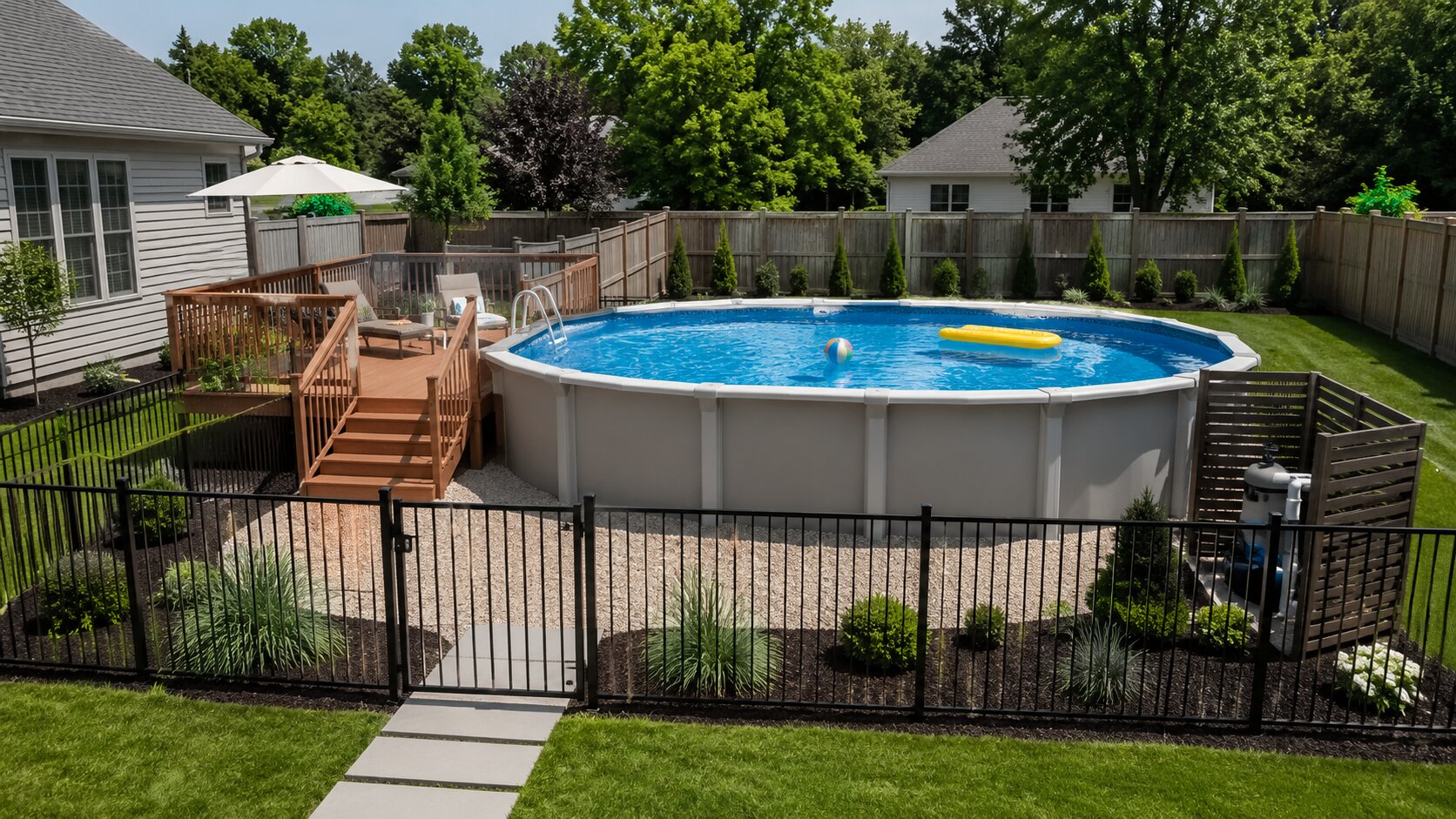
An above-ground pool can turn an ordinary backyard into a practical summer retreat, but the best designs begin with site planning and safety rather than decoration. The pool needs level support, legal placement, secure access, drainage, electrical protection, reliable circulation, and enough working room for inspection and maintenance. Decks, privacy screens, plants, lighting, and furniture should improve the setting without creating climbing aids, blocking equipment, or interfering with the pool structure.
Quick answer: Start by confirming zoning, setbacks, permits, barrier rules, utilities, and the manufacturer’s installation requirements. Then choose a pool location with stable level ground, safe access, good drainage, and adequate clearance from buildings, fences, trees, power lines, and underground utilities. Add the deck, landscape, and entertainment features only after the complete safety and service plan is clear.
Drowning prevention must remain the first design priority. The U.S. Centers for Disease Control and Prevention reports that more children ages 1 to 4 die from drowning than from any other cause of death in the United States. A beautiful pool area therefore needs multiple layers of protection, including active supervision, a compliant barrier, secured access, appropriate alarms or covers where required, and a clear emergency plan.
If the pool will serve a compact rural home, shop house, or barn-style residence, review Archlux’s barndominium floor plans guide to coordinate backyard circulation, utility routes, patios, and future expansion before the site becomes crowded.
Above-Ground Pool Planning at a Glance
| Planning topic | Practical guidance |
| Best first step | Confirm legal placement, permits, barrier requirements, utilities, and manufacturer instructions. |
| Most important site issue | A level, stable base with controlled drainage and no conflict with underground or overhead utilities. |
| Most important safety issue | Prevent unsupervised access with layered protection and active supervision. |
| Best deck strategy | Use a permitted, independently supported, structurally designed deck that does not damage or restrain the pool wall. |
| Best landscaping strategy | Use low-maintenance planting outside the barrier and keep roots, mulch, furniture, and stones away from the pool structure and access zone. |
| Best maintenance strategy | Keep equipment accessible, test water regularly, follow product labels, and inspect the pool, ladder, deck, barrier, and electrical components. |
| Regulatory reality | Rules vary by state, county, city, HOA, and adopted code edition. The local authority having jurisdiction controls the project. |
What Counts as an Above-Ground Pool?
Above-ground pool is a broad consumer term. It can describe a seasonal inflatable pool, a framed storable pool, a rigid-wall kit, or a permanent pool that sits partly or entirely above grade. The legal classification may depend on water depth, installation method, permanence, electrical equipment, deck construction, and the locally adopted swimming-pool code.
The 2024 International Swimming Pool and Spa Code separates on-ground storable residential pools from permanent residential pools. It is a model code, not a single nationwide law. A state or local jurisdiction may adopt a different edition, amend the provisions, or use a separate residential code. Ask the local building department how it classifies the specific product before buying or preparing the site.
Do not assume that a removable or seasonal pool is exempt from permits or barriers. Some jurisdictions regulate portable pools once they exceed a specified depth or water capacity. Homeowner-association rules, easements, septic fields, utility corridors, and property-line setbacks can create additional restrictions.
15 Practical Above-Ground Pool Ideas
The following ideas focus on function, durability, and safety. Adapt them to the selected pool, the site, the local climate, and the approved permit documents. Never modify the pool wall, frame, supports, liner, circulation system, or access system unless the manufacturer expressly permits the modification.
1. Keep the Pool Ground-Level and Simple
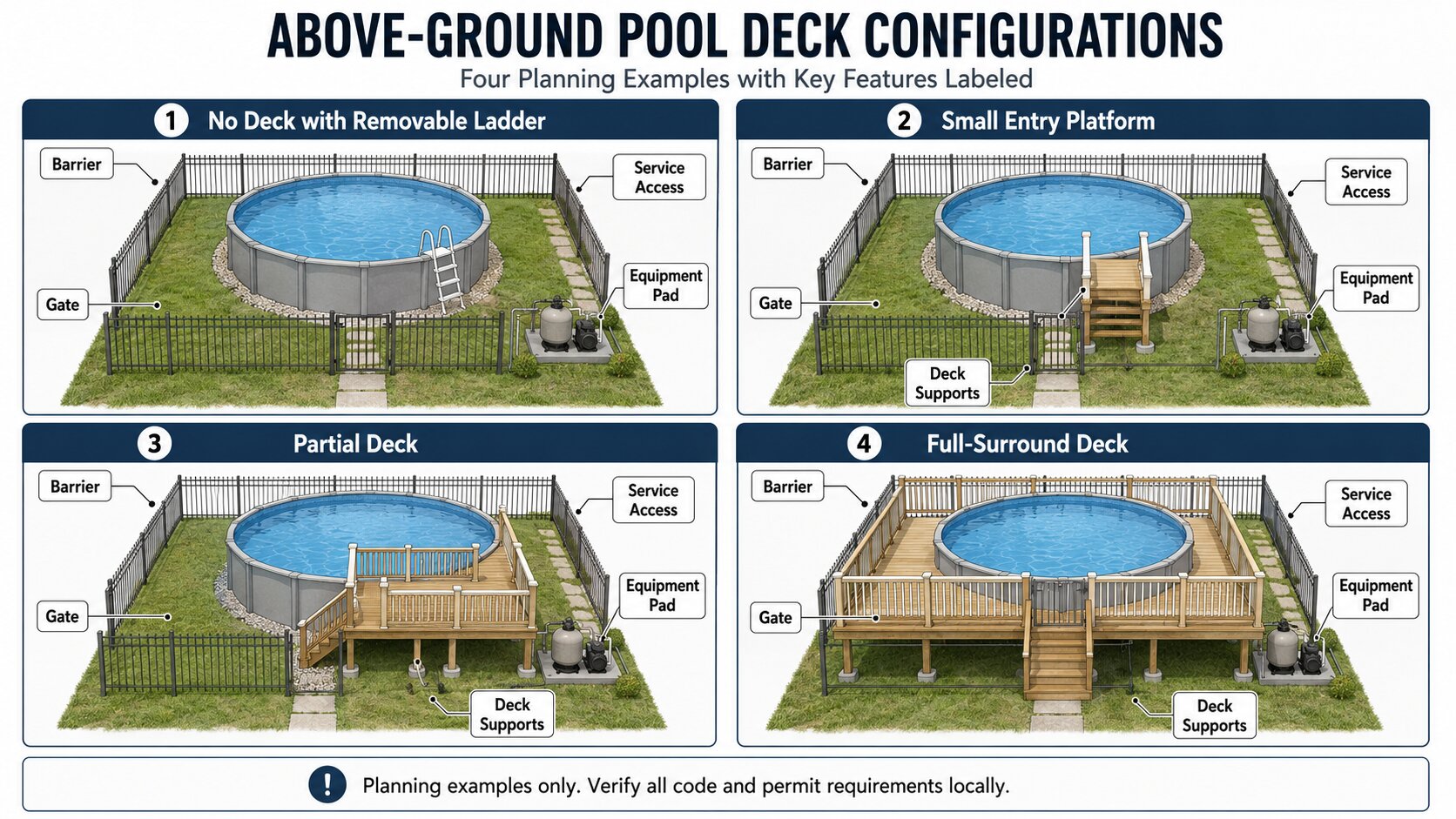
A clean ground-level installation can be the most economical and maintainable option. Use the base material required by the manufacturer, establish drainage away from the pool, and create a stable perimeter that reduces mud and vegetation without trapping moisture against the wall. A small entry platform can improve access without surrounding the entire pool.
2. Add a Compact Partial Deck
A partial deck creates a controlled entry point and a place for one or two chairs while leaving most of the pool wall visible for inspection. It can work well in small yards. The deck should be independently supported, permitted where required, and coordinated with the barrier and gate. Maintain the clearances required by the pool and deck designs.
3. Build a Full-Surround Deck Only When the Site Supports It
A full deck can make an above-ground pool feel integrated with the backyard. It also adds cost, structural load, railings, gates, foundations, and maintenance. The deck must not rely on the pool wall for support unless an engineered system specifically allows it. Provide removable or accessible sections where equipment, wall connections, and liner components require service.
4. Use a Round Pool for a Compact Backyard
Round pools distribute water pressure efficiently and often fit smaller lots. A restrained landscape and a curved gravel or paver path can make the shape feel intentional. Before selecting diameter, mark the complete footprint, including supports, ladder, barrier, equipment, setbacks, and walking space.
5. Choose an Oval or Rectangular Pool for Defined Activity Zones
Longer pools can support casual exercise, games, or a clearer shallow-to-deep orientation when the product is designed for it. Their structural supports may extend well beyond the visible wall. Measure the manufacturer’s full support footprint, not only the water dimensions.
6. Create a Partially Recessed Appearance Without Improvised Burial
A sloping site may allow the pool to appear lower on one side. Do not bury or backfill against a pool unless the manufacturer specifically approves that installation and the drainage and retaining conditions are professionally designed. Soil pressure and trapped water can damage a pool intended to stand freely above grade.
7. Connect the Pool to an Existing Patio With a Safe Transition
A path or small landing can connect the pool to a patio without requiring a complete deck. Maintain clear separation between the pool barrier and climbable patio furniture. Use slip-resistant walking surfaces and control runoff so the patio does not direct water toward the pool foundation.
8. Add Privacy with a Fence or Screen Outside the Service Zone
Privacy screens can make the pool more comfortable, but they should not create handholds, footholds, blind spots, or maintenance obstructions. Place them according to barrier and setback rules. Preserve ventilation around equipment and provide a clear route for filter, pump, and liner service.
9. Use Low-Maintenance Landscaping That Does Not Damage the Pool
Choose plants with manageable roots and limited leaf litter. Keep thorny plants, aggressive roots, irrigation spray, and heavy mulch away from the wall and supports. Maintain visibility around the pool so caregivers can supervise the water from the yard or home.
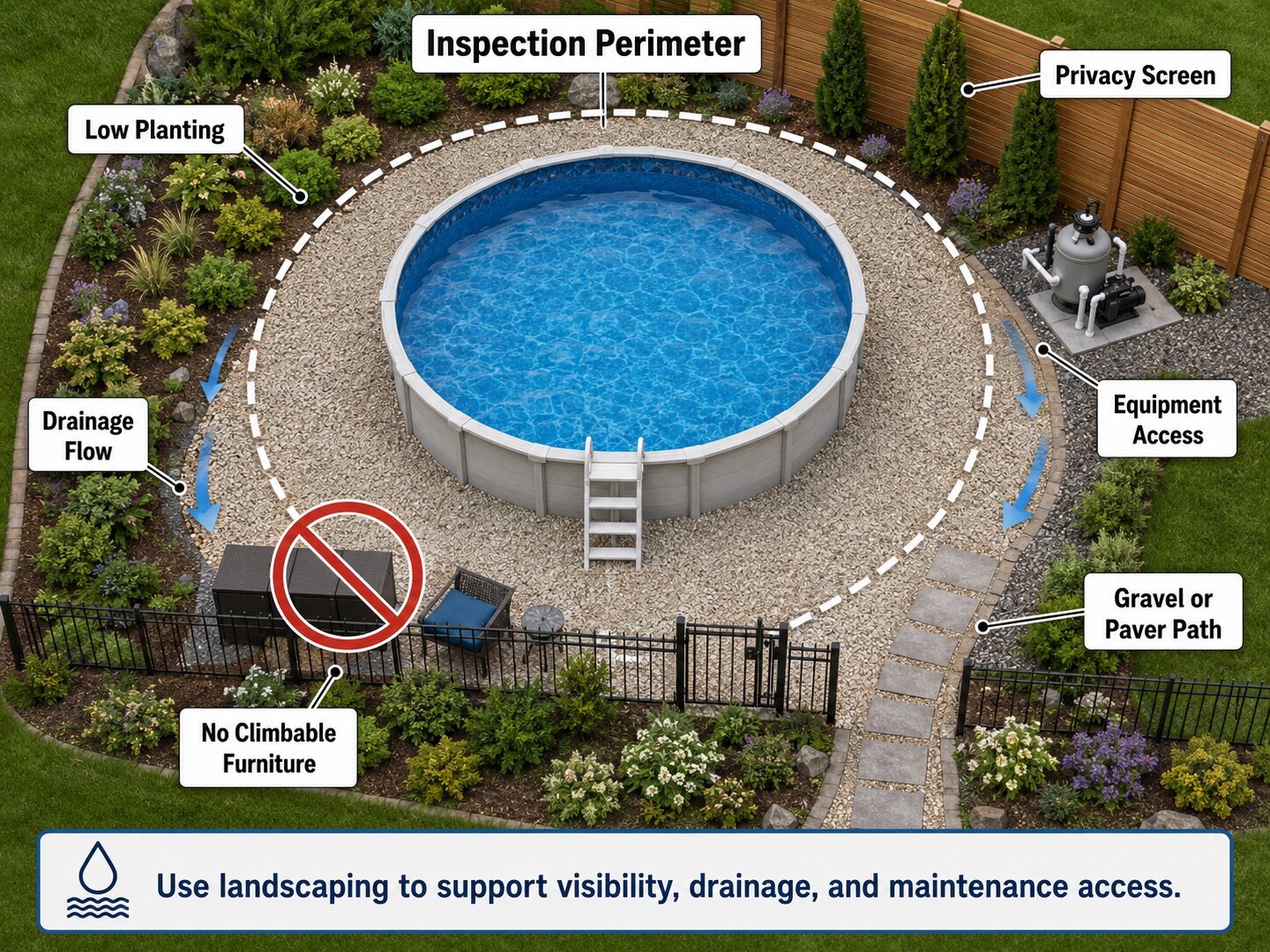
10. Create a Gravel or Paver Perimeter for Drainage and Inspection
A neat perimeter can reduce mud and make leaks or settlement easier to notice. The detail should drain away from the pool and should not bury the lower frame, supports, or wall. Avoid loose stones where they could damage a liner or become trip hazards.
11. Screen the Equipment Without Enclosing It Improperly
A slatted screen or small equipment yard can reduce visual clutter. Maintain manufacturer-required airflow, electrical clearances, drainage, and service access. Pool chemicals should not be stored in a tightly enclosed equipment box with incompatible products or ignition sources.
12. Add Shade Beside the Pool, Not Over Critical Structures
A freestanding umbrella, shade sail, or pergola can improve comfort. Coordinate foundations, wind loads, overhead lines, setbacks, and the pool barrier. Do not attach shade structures to the pool frame or place supports where children can use them to climb into the water.
13. Use Purpose-Designed Outdoor Lighting
Low-glare lighting can improve visibility at gates, stairs, paths, and equipment areas. All electrical work near water should be designed and installed by qualified professionals under the locally adopted electrical code. Do not rely on household extension cords, indoor fixtures, or portable electronics near the pool.
14. Create a Dedicated Safety and Storage Station
Keep a reaching pole, ring buoy or other appropriate rescue equipment, first-aid supplies, emergency contacts, and pool rules in a visible, accessible location. Store toys after use so they do not attract children toward the water. Keep chemicals locked and separate from general pool accessories.
15. Build an Entertaining Zone Outside the Barrier
Place dining, grilling, and bar seating far enough from the water to preserve the barrier and a clear supervision route. Keep grills, glassware, electrical appliances, and loose furniture outside the pool enclosure whenever practical. For inspiration, review Archlux’s outdoor bar ideas, then adapt any concept to current fire, electrical, food-service, and pool-barrier requirements.
Related Archlux guide: Outdoor Bar Ideas. This legacy page should be treated as visual inspiration only until its safety and editorial update is completed.
Plan the Site Before Ordering the Pool
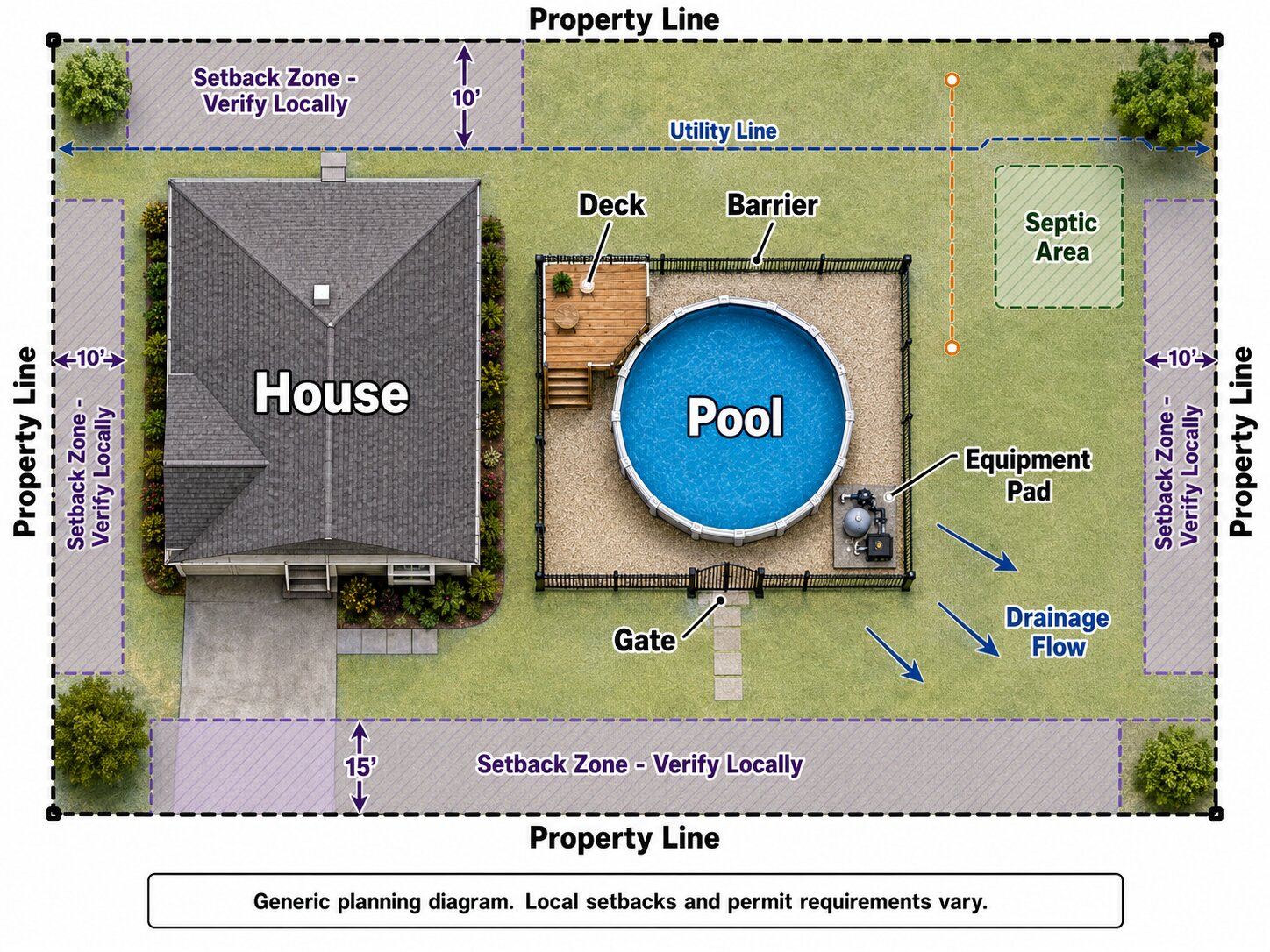
A pool catalog shows the water dimensions, but the property must accommodate much more. Plan for the pool wall, buttresses or support legs, pump and filter, ladder or stairs, barrier, gate, deck footings, drainage, required setbacks, utility access, maintenance paths, and emergency access.
- Contact the local planning and building departments. Ask about permits, setbacks, barrier rules, electrical permits, deck permits, lot coverage, drainage, and final inspection.
- Contact the utility-location service before excavation or staking. Confirm private utilities, septic components, irrigation, and low-voltage systems that public utility marking may not identify.
- Review the property survey, easements, drainage paths, and HOA requirements.
- Mark the manufacturer’s complete footprint, including every support and equipment connection.
- Check overhead power lines, tree branches, roof drainage, retaining walls, slopes, and vehicle access.
- Identify where drained or backwashed water can legally go without harming neighboring property, structures, soil, or surface water.
Ground Preparation and Drainage
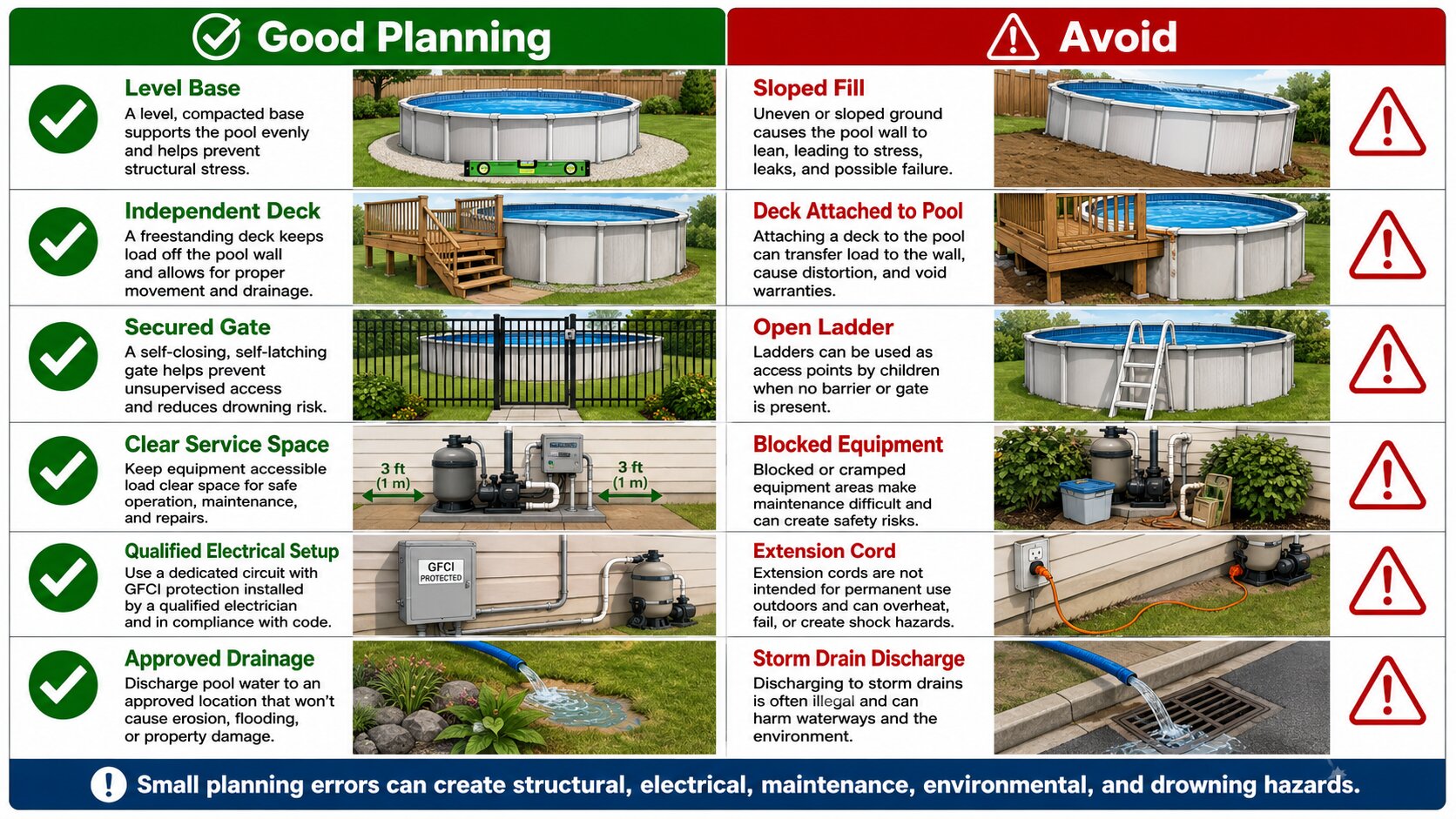
Above-ground pools place a large, continuous load on the soil. The base must be prepared according to the pool manufacturer’s instructions. Improvised filling, uneven soil, organic topsoil, poorly compacted material, or a sloped base can lead to settlement, wrinkling, frame distortion, liner stress, and uneven water depth.
Remove vegetation and unstable material as required. Establish a level bearing surface using the approved base system. Protect the pool from roof runoff, hillside drainage, irrigation, and ponding. Do not create a decorative berm or raised planting bed that traps water against the wall or support system.
If the site needs a retaining wall, major excavation, deep fill, or drainage structure, involve qualified local professionals. The pool installer, landscape contractor, and deck contractor should work from the same survey and finished elevations.
Deck Design and Structural Safety
A deck changes the pool from a product installation into a building project. It introduces footings, beams, joists, guards, stairs, gates, live loads, lateral loads, frost or soil concerns, and connections. Many jurisdictions require a permit and inspections.
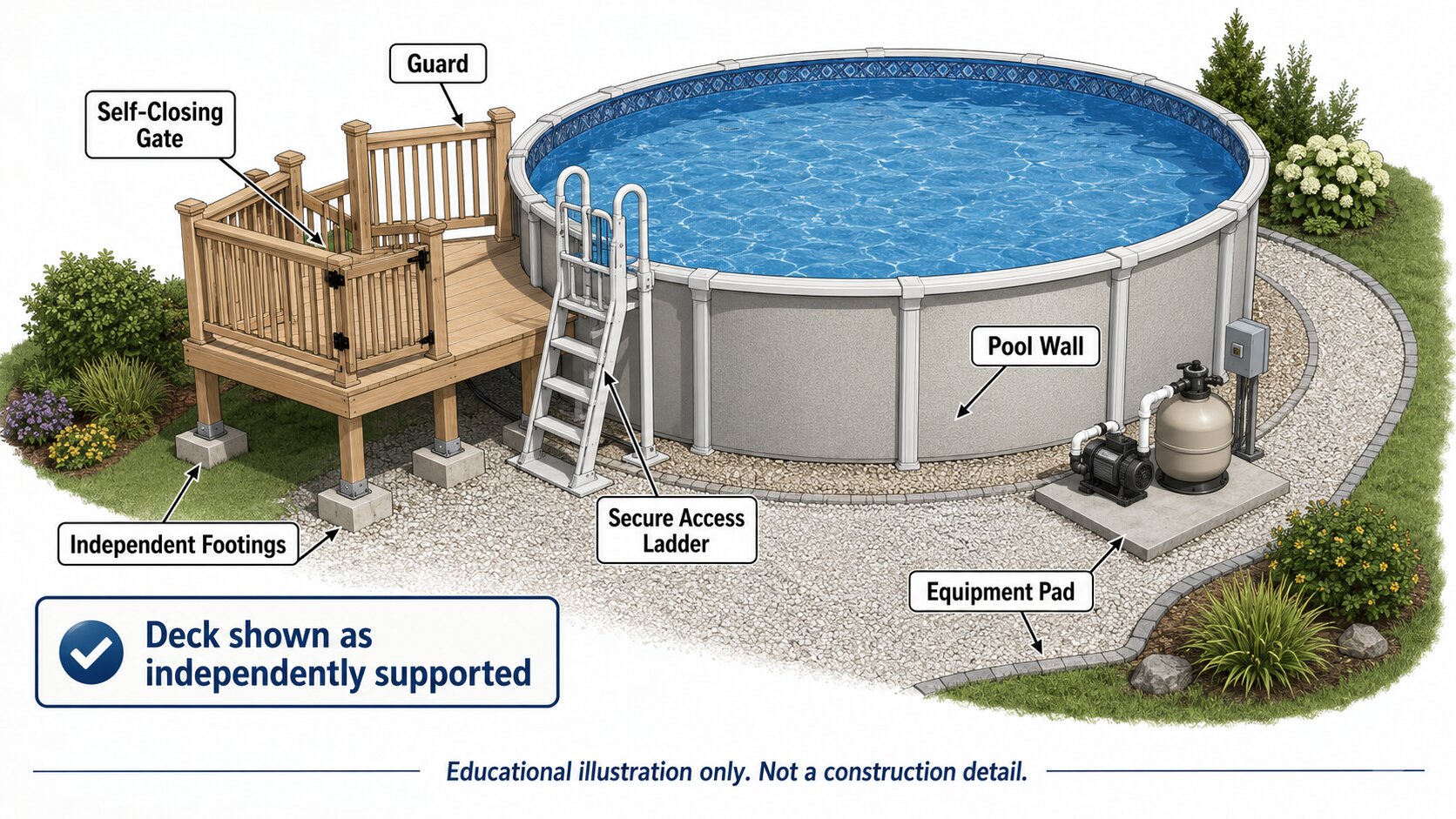
- Use independently supported deck framing unless the pool manufacturer and engineered design expressly permit another connection.
- Do not screw, bolt, clamp, or bear deck framing against the pool wall or top rail without written approval.
- Coordinate deck height with the pool top, liner replacement, cover operation, skimmer service, and winterization.
- Provide guards, handrails, stairs, gates, and openings required by the locally adopted code.
- Use slip-resistant walking surfaces and avoid protruding fasteners or sharp edges.
- Keep deck furniture and storage boxes from becoming climbing aids near the barrier.
- Preserve access to supports, plumbing, electrical equipment, valves, and the pool wall.
Barriers, Gates, Ladders, and Child Safety
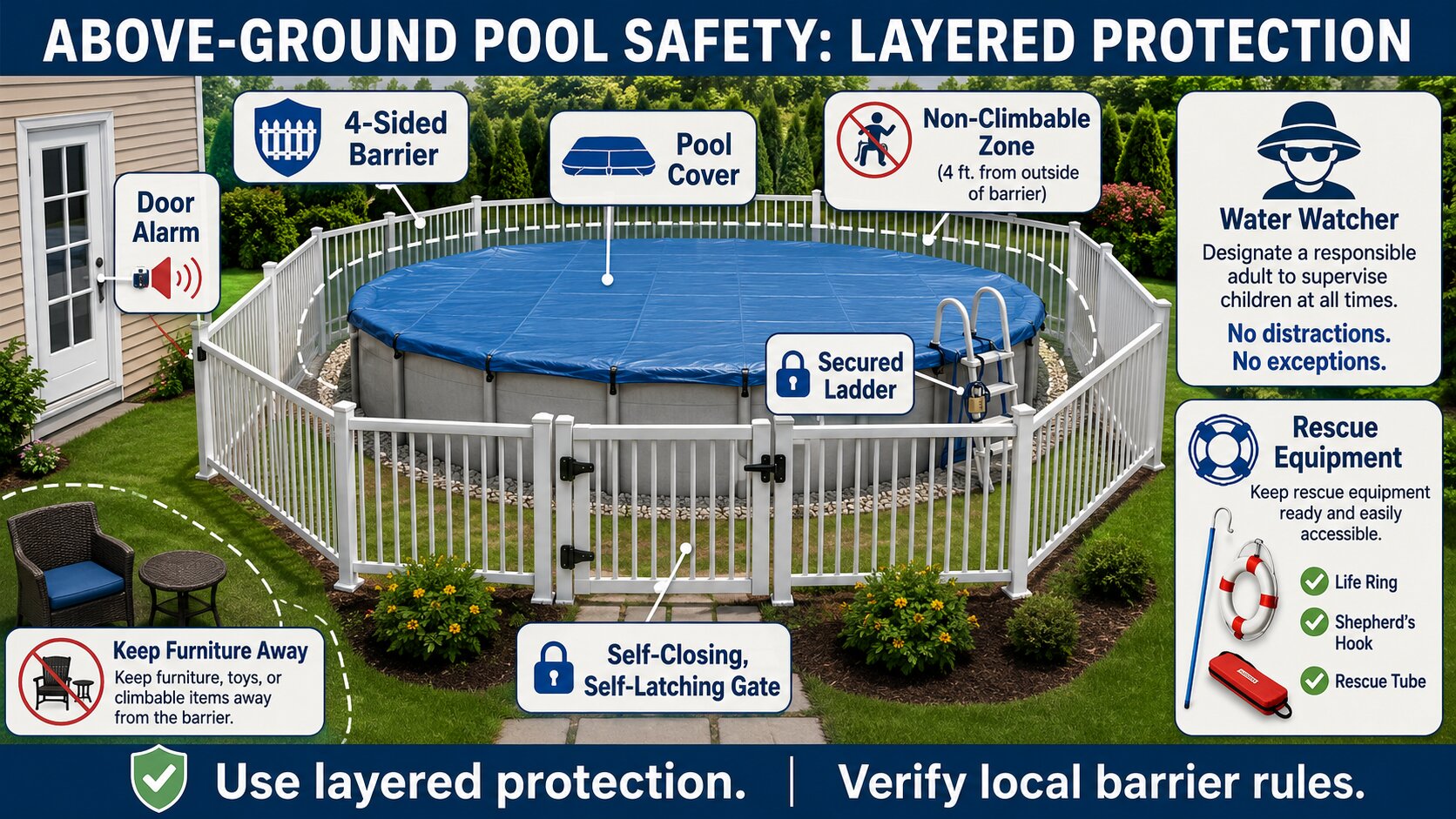
A pool barrier is a layer of protection, not a substitute for supervision. CPSC guidance recommends a barrier that completely surrounds the pool rather than relying on the house as one side. The guidance states that barriers should be at least 48 inches high, with openings and clearances designed to prevent young children from climbing over, crawling under, or passing through. The 2024 International Swimming Pool and Spa Code also uses a 48-inch minimum barrier height in its model provisions. Local law may be different or more restrictive.
For an above-ground pool, the pool wall may serve as part of the barrier when it is high enough and the installation meets local requirements. Access remains critical. CPSC guidance states that steps or ladders should be secured, locked, or removed when the pool is not in use, or protected by a compliant barrier. A removable ladder alone may not be enough when other features create footholds.
In 2025 and 2026, CPSC announced recalls of several 48-inch and taller above-ground pools because an exterior compression strap could create a foothold. Children could use the strap to enter the pool even after the ladder was removed. Check the pool’s brand and model against current CPSC recalls before installation and during ownership.
- Use active, focused adult supervision whenever the pool is accessible.
- Assign a designated water watcher during gatherings. Do not assume another adult is watching.
- Keep the gate closed and never prop it open.
- Remove toys from the water and deck after use.
- Keep chairs, tables, planters, pumps, filters, and landscaping features away from the climbable side of the barrier.
- Use alarms, covers, and access controls as additional layers where appropriate. Do not treat one device as complete protection.
- Learn CPR and keep appropriate rescue equipment available.
Electrical Safety Around the Pool
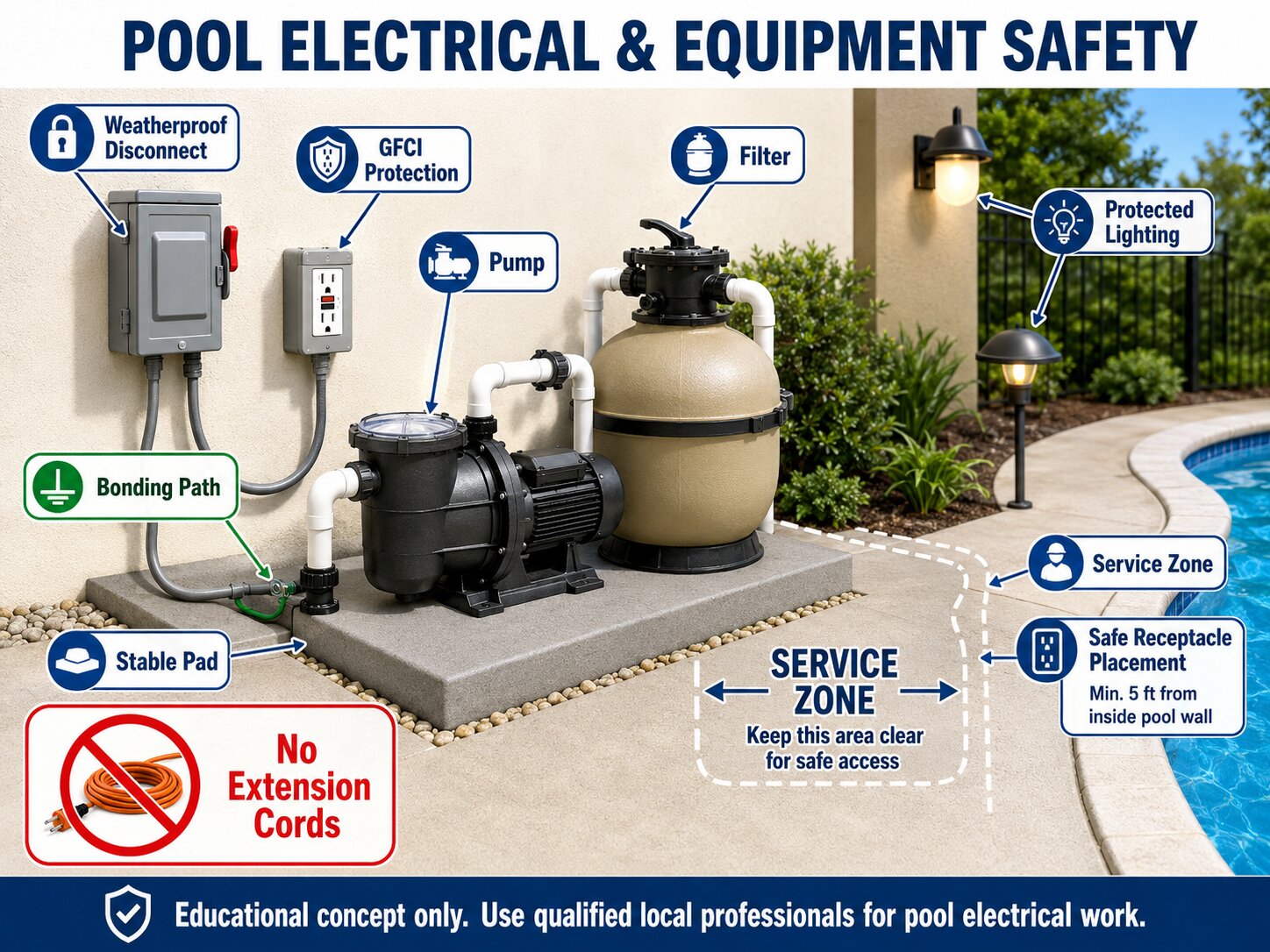
Water, wet skin, metal components, and outdoor electricity create a serious shock and electrocution hazard. CPSC advises pool owners to protect lights, receptacles, switches, pumps, filters, and other electrical equipment with appropriate ground-fault circuit-interrupter protection and to have electrical systems inspected and corrected by qualified professionals.
- Use a licensed electrical professional familiar with pools and the locally adopted electrical code.
- Provide approved GFCI protection, grounding, bonding, disconnects, receptacles, and wiring methods as required.
- Do not power a pool pump with a household extension cord unless a listed product and local rules expressly allow the complete arrangement. Permanent installations normally require a compliant circuit.
- Keep portable radios, speakers, chargers, appliances, and damaged cords away from the water.
- Inspect older underwater lights, receptacles, covers, and equipment for deterioration.
- Check clearances from overhead power lines before selecting the pool location.
- Stop use immediately if swimmers feel tingling, muscle cramps, or shocks. Do not enter the water to rescue someone until electrical power is disconnected by a safe means.
Water Quality, Circulation, and Chemical Safety
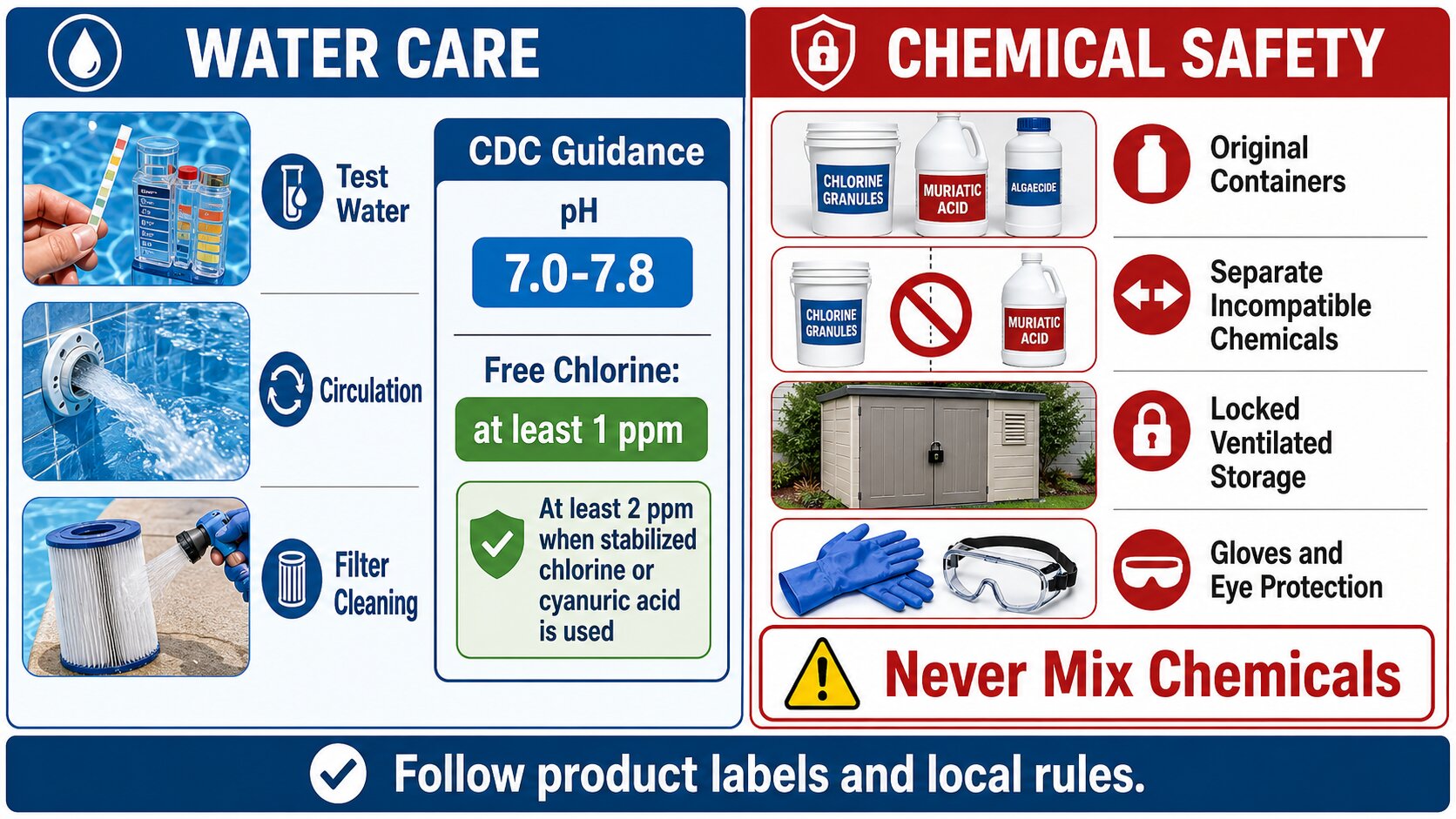
Clear water is not automatically safe water. Test and maintain the pool according to the manufacturer, sanitizer label, and local health guidance. CDC recommends a pH of 7.0 to 7.8 and at least 1 part per million free chlorine in pools. When cyanuric acid or stabilized chlorine products are used, CDC recommends at least 2 parts per million free chlorine. Product labels and local requirements may establish additional limits.
- Test disinfectant and pH regularly, especially after heavy use, rain, hot weather, or water replacement.
- Maintain circulation, filtration, skimming, and cleaning according to the equipment instructions.
- Never mix chlorine products with acids, ammonia, other chlorine products, or unknown chemicals.
- Add chemicals only as directed by the product label. Use clean, dedicated tools.
- Store chemicals in original containers, dry, secured, ventilated, and away from children, heat, flames, metal corrosion, and incompatible products.
- Do not store chemicals in the same small enclosed cabinet as pumps, heaters, fuels, or electrical equipment unless a qualified design and product instructions allow it.
- Keep safety data and emergency information available.
CDC’s Model Aquatic Health Code is designed primarily for public aquatic facilities, but its chemical-storage principles provide useful context for larger shared or hospitality pools. Private homeowners should follow the product label, manufacturer instructions, and local fire, environmental, and health requirements.
Draining, Backwashing, and Stormwater
Do not assume pool water can be discharged to the street, storm drain, creek, neighbor’s yard, or septic system. Chlorine, salt, algaecides, pH-adjusting chemicals, sediment, and high flow can harm waterways, landscaping, structures, and wastewater systems. EPA notes that many communities prohibit or regulate chlorinated pool-water discharge.
Before draining or backwashing, contact the local stormwater, wastewater, or environmental authority. Follow the pool and chemical-product labels. The approved method may require dechlorination, controlled flow to a suitable vegetated area, discharge to a sanitary sewer with permission, or another location. Prevent erosion, flooding, basement entry, slope failure, and discharge across neighboring property.
Landscaping, Privacy, and Visual Integration
The safest landscape keeps the pool visible, serviceable, and dry. Use plants and materials to frame the area, not to hide structural problems or block supervision. A narrow bed of low plants outside the service perimeter often works better than dense planting against the wall.
- Choose plants that tolerate splashing and local climate conditions without aggressive roots.
- Avoid thorny plants, poisonous plants, bee-attracting flowers near entries, and trees that drop heavy debris.
- Keep irrigation heads from spraying the pool wall, equipment, electrical components, or deck framing.
- Do not stack stones, planters, firewood, or furniture where children can climb over the barrier.
- Use corrosion-resistant screens that remain removable for equipment service.
- Provide drainage beneath decorative gravel and do not bury the pool frame or supports.
Lighting, Shade, and Outdoor Comfort
Comfort features should support safe use rather than create clutter. Provide shade for supervising adults, low-glare pathway lighting, a dry towel and storage area, and seating that does not block the gate or become a climbing aid. Keep glass containers and breakable decor away from the pool enclosure.
For nighttime use, illuminate the water surface, gate, stairs, deck edges, walking routes, and equipment area. Avoid glare that prevents a watcher from seeing below the water. Use listed outdoor equipment installed by qualified professionals.
Accessibility and Shared or Public Use
A private pool serving one household can still be planned for step-free routes, stable deck surfaces, supportive handholds, transfer assistance, and aging in place. A pool at a hotel, club, public facility, certain rental or hospitality property, condominium, or other shared setting may face additional accessibility, public-health, operator, and inspection requirements.
The U.S. Department of Justice explains that public entities and public accommodations must provide accessible pool entry in circumstances covered by the 2010 ADA Standards. Do not assume a residential-looking above-ground pool is exempt when it serves the public or a shared program. Obtain project-specific legal and code guidance.
Cost Planning Without Misleading Price Claims
The pool kit is only one part of the project cost. Two properties using the same pool can have very different totals because of permits, access, grading, soil conditions, electrical service, deck construction, fencing, drainage, landscaping, covers, equipment, and seasonal maintenance.
| Cost category | Items to include |
| Pool package | Pool wall or frame, liner, supports, pump, filter, ladder, skimmer, fittings, and included accessories. |
| Site preparation | Survey, permits, utility marking, clearing, excavation, base material, compaction, grading, and drainage. |
| Electrical work | Circuit, GFCI protection, bonding, grounding, disconnects, receptacles, lighting, inspection, and possible service upgrades. |
| Barrier and access | Fence, gates, alarms, covers, secured ladder or stairs, deck guards, and locks. |
| Deck or patio | Design, permits, footings, framing, decking, guards, stairs, gates, and finish. |
| Water care | Testing supplies, sanitizer, balancing chemicals, filter media, cleaning tools, replacement water, and professional service. |
| Seasonal ownership | Opening, closing, cover, winterization, repairs, liner replacement, pump replacement, and insurance changes. |
Common Above-Ground Pool Mistakes
- Buying the pool before confirming legal placement, barriers, electrical requirements, and the complete footprint.
- Leveling by adding loose fill under one side instead of preparing a stable base according to the manufacturer.
- Attaching a deck, cladding, wall, waterfall, or screen directly to the pool without written approval and engineered coordination.
- Burying or partially burying a pool not designed for soil pressure.
- Relying only on a removable ladder for child safety.
- Placing furniture, planters, filters, pumps, or landscaping where they create footholds near the barrier.
- Using extension cords or unqualified electrical work near water.
- Blocking inspection and liner-replacement access with decks or decorative cladding.
- Storing incompatible pool chemicals together or in a hot, damp, unventilated cabinet.
- Draining chlorinated water into a storm drain or neighboring property without local approval.
- Assuming a clear appearance means the water is sanitary.
- Failing to check product recalls and inspect straps, frames, ladders, fasteners, electrical equipment, and the liner.
Above-Ground Pool Planning Checklist
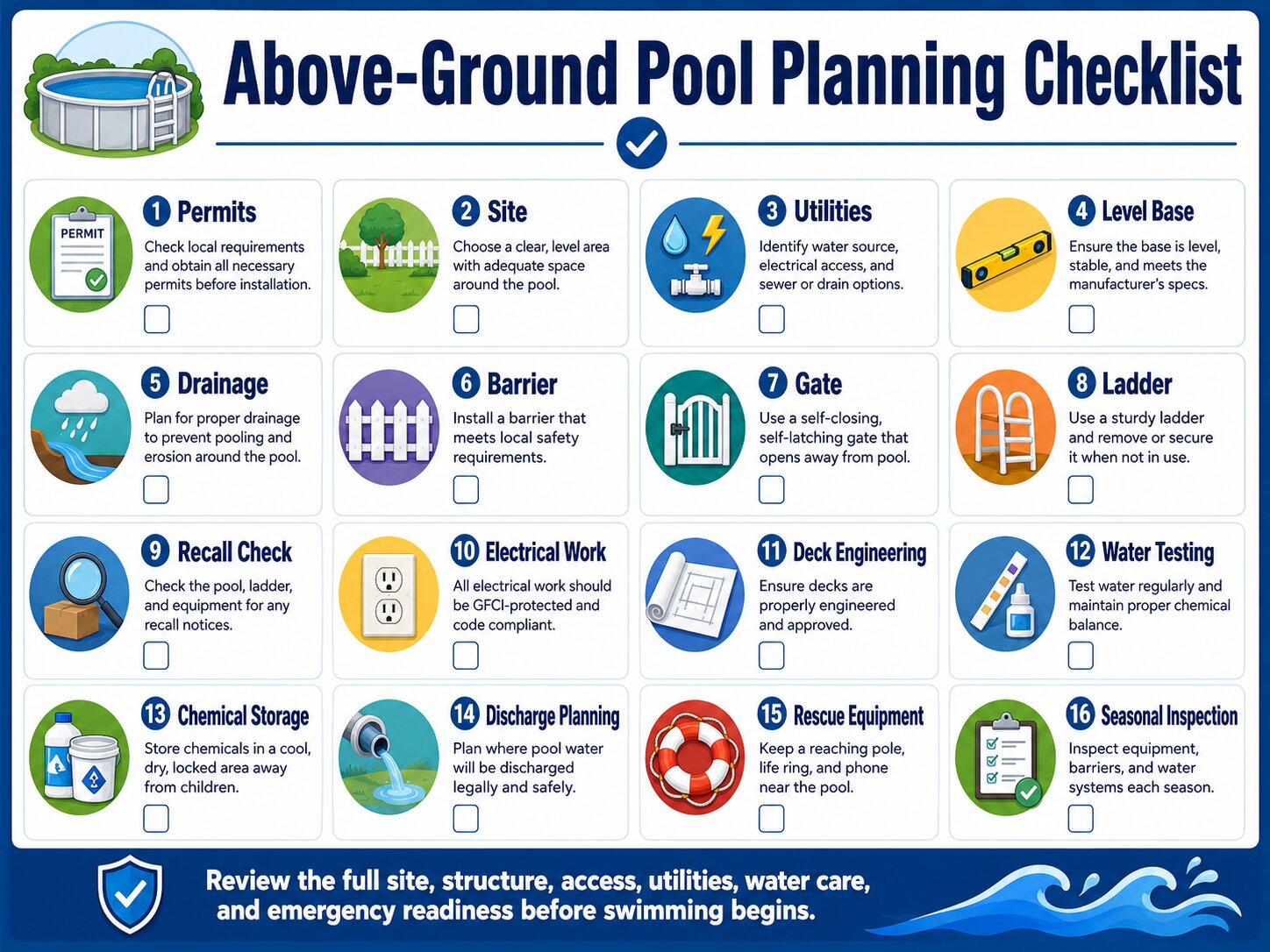
- Confirm zoning, permits, setbacks, HOA rules, and the adopted pool code.
- Check utility locations, easements, septic components, drainage, and overhead lines.
- Review the manufacturer’s complete installation and site requirements.
- Mark the pool, supports, equipment, barrier, gate, ladder, deck, and service paths.
- Prepare a level, stable base and a drainage plan.
- Design layered access protection and active-supervision procedures.
- Check the current CPSC recall database for the pool and accessories.
- Use qualified professionals for electrical work and structural decks.
- Keep equipment ventilated and serviceable.
- Store pool chemicals securely in original containers and separate incompatible products.
- Maintain water chemistry and circulation according to CDC guidance, product labels, and local rules.
- Plan legal draining and backwashing before the first water change.
- Provide rescue equipment, emergency contacts, and CPR-trained caregivers.
- Inspect the pool wall, frame, supports, ladder, barrier, deck, electrical system, and equipment throughout the season.
Frequently Asked Questions
Do above-ground pools need a permit?
Many do, but requirements vary by location, pool size, water depth, permanence, deck work, electrical work, and local code. Contact the planning and building departments before buying or preparing the site.
Can the pool wall count as the required barrier?
Sometimes. CPSC guidance and model codes recognize that a sufficiently high above-ground pool wall can serve as part of a barrier when access is properly secured. Local rules determine whether the specific pool, wall height, ladder, deck, and surrounding conditions comply.
Is removing the ladder enough to keep children out?
No single measure is enough. CPSC recalls have shown that exterior straps or other features can create footholds even when the ladder is removed. Use a compliant barrier, secured access, active supervision, and additional layers such as alarms or covers where appropriate.
Can I build a deck around an above-ground pool?
Yes, when the property allows it and the deck is permitted, structurally designed, independently supported as required, and coordinated with the pool, barrier, access, electrical system, maintenance, and liner replacement.
Can I partially bury an above-ground pool?
Only when the manufacturer specifically approves the installation and the soil, drainage, corrosion protection, retaining conditions, and permits are addressed. Do not backfill against a freestanding pool that was not designed for soil pressure.
Can I disguise the pool wall with wood or stone?
Use independent screens, skirting, or landscape elements that preserve ventilation, inspection, drainage, and service access. Do not drill, fasten, lean, or apply loads to the pool wall without manufacturer approval.
What chlorine and pH levels should a home pool maintain?
CDC recommends a pH of 7.0 to 7.8 and at least 1 ppm free chlorine in pools. If cyanuric acid or stabilized chlorine is used, CDC recommends at least 2 ppm. Follow the product label, manufacturer instructions, and local requirements.
Can I use an extension cord for the pool pump?
Do not improvise pool power with ordinary household extension cords. Have a qualified electrical professional provide the wiring, GFCI protection, bonding, grounding, and disconnects required by the product and locally adopted electrical code.
Where should I drain an above-ground pool?
Ask the local stormwater, wastewater, or environmental authority. Chlorinated, salted, or chemically treated water may be prohibited from storm drains and surface waters. The approved method may require dechlorination, controlled land application, or sanitary-sewer permission.
Are shipping-container pools an inexpensive DIY alternative?
Not automatically. A container conversion requires structural evaluation, corrosion protection, waterproofing, safe edges, circulation, barriers, electrical work, drainage, and permits. Treat it as a custom engineered pool project, not a simple reuse hack.
Does the ADA apply to a private backyard pool?
A pool used only by one household generally differs from a pool serving a public entity or public accommodation. Shared, hospitality, public-facing, or program pools may trigger ADA and public-pool requirements. Obtain project-specific guidance when the use extends beyond a private household.
Final Thoughts
The strongest above-ground pool ideas are not the most elaborate. They are the designs that fit the property, preserve drainage, provide secure access, keep equipment serviceable, protect swimmers, and remain manageable throughout the season. Begin with permits, the manufacturer’s instructions, a complete site plan, and layered safety. Then add the deck, planting, privacy, lighting, and furniture that make the backyard enjoyable.
Treat every pool as a serious water environment. Supervision, barriers, electrical protection, water quality, maintenance, and emergency readiness matter more than any visual upgrade.
| Editorial disclosure This article was researched and edited by the Archlux Editorial Team. Artificial intelligence tools may assist with research organization, content development, and language refinement. Safety and regulatory statements were checked against cited U.S. government and model-code sources. This content provides general educational information and does not replace project-specific advice from local building officials, pool manufacturers, licensed contractors, qualified electricians, engineers, health authorities, environmental authorities, insurers, or legal professionals. |
References and Authoritative Resources
- CDC: Drowning Facts. Current U.S. drowning facts, including the elevated risk to children.
- CPSC: Safety Barrier Guidelines for Residential Pools. Guidance on barriers, gates, openings, above-ground pool walls, and access ladders.
- CPSC: Pool Safely. Federal pool-safety education and layered-prevention resources.
- CPSC: Bestway, Intex, and Polygroup Above-Ground Pool Recall. Recall involving exterior compression straps that could create footholds.
- CPSC: Electrical Safety In and Around Pools, Spas and Hot Tubs. Guidance on electrical hazards, GFCIs, equipment, cords, and pool lighting.
- CDC: Home Pool and Hot Tub Water Treatment and Testing. Home-pool disinfectant and pH recommendations.
- CDC: Guidelines for Keeping Your Pool Safe and Healthy. Healthy-swimming practices and water testing guidance.
- CDC: Model Aquatic Health Code. Science-based guidance for public aquatic venues and chemical-safety context.
- ICC: 2024 International Swimming Pool and Spa Code, General Compliance. Model-code barrier and general safety provisions. Local adoption controls.
- ICC: 2024 ISPSC, On-Ground Storable Residential Swimming Pools. Model provisions for on-ground storable residential pools.
- EPA: Safely Discharging Chemically Treated Water. Community guidance on pool and hot-tub water discharge. Verify local requirements.
- U.S. Department of Justice: Accessible Pools Requirements. ADA context for pools serving public entities and public accommodations.